
🐶 Calculate Your Dog's Human Age
Much more than a simple 7-year rule: discover how size, breed, and genetics truly determine your companion's age.
What is the equivalence between your dog's age and human age? It's a question we all ponder — and the answer is far more fascinating than we might think. Understanding your companion's actual age will help you better tailor its care, diet, and activities.
🔍 1. The 7-Year Rule: Myth or Reality?
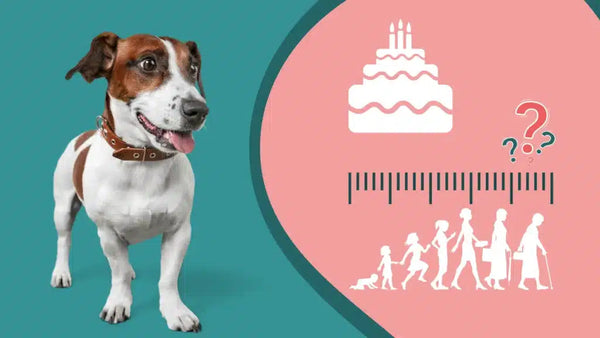
It is common to hear that each year of a dog's life is equivalent to seven human years. But don't be fooled: the reality is far more nuanced!
The “seven-to-one” rule is a convenient simplification, but it does not account for the diversity among canine breeds, sizes, and genetics. In reality, a 1-year-old puppy is already sexually mature — corresponding more closely to a 15-year-old human adolescent than to a 7-year-old child.
💡 Did you know? In 2020, researchers from the University of California proposed a logarithmic formula that is much more accurate than the 7-year rule, based on epigenetic changes in canine and human DNA.
| Dog's age | Human equivalent (7-year rule) | Human equivalent (actual) |
|---|---|---|
| 1 year | 7 years | ~15 years |
| 2 years | 14 years | ~24 years |
| 5 years | 35 years | ~36 years |
| 10 years | 70 years | ~68 years |
| 15 years | 105 years | ~83 years |
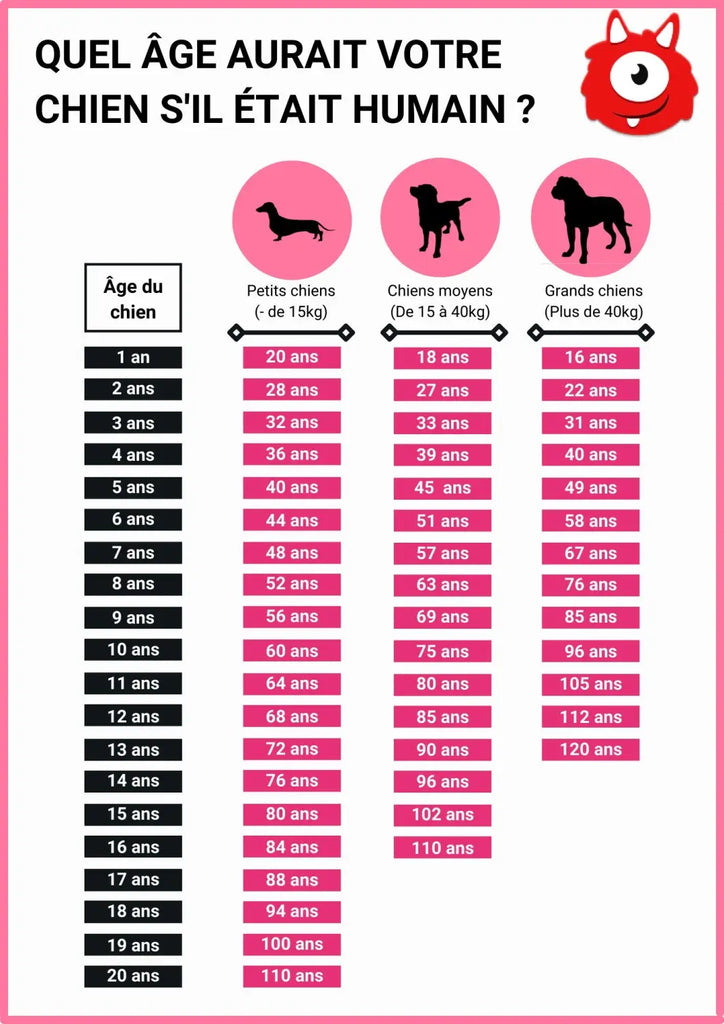
🐕 2. Size, Breed, and Genetics: The Real Factors
Life expectancy varies considerably between small and large breeds. Small dogs tend to live longer than their larger counterparts — a paradox compared with the animal kingdom in general.
Life expectancy by size
| Category | Weight | Average life expectancy |
|---|---|---|
| 🐩 Very small breed | < 5 kg | 14–16 years |
| 🐕 Small breed | 5–10 kg | 13–15 years |
| 🦮 Medium breed | 10–25 kg | 11–13 years |
| 🐕🦺 Large breed | 25–45 kg | 9–11 years |
| 🦣 Very large breed | > 45 kg | 7–9 years |
Genetics also plays a major role: some breeds age faster, while others benefit from an active, longer life. Thus, the canine age equation cannot be solved without taking these individual parameters into account.
🐾 Example: A 10-year-old Chihuahua is still relatively alert, while a Great Dane of the same age is considered very old for its breed.
❤️ 3. Health, Nutrition, and Longevity
Health and lifestyle are pieces of the puzzle needed to understand our loyal companions' true age. Here are the essential factors for promoting their longevity.
✅ The pillars of a long and happy canine life
- 1 🥩 A diet suited to age and size — Nutritional needs change from puppy to adult to senior. Choose food formulated for your dog's life stage.
- 2 🏃 Regular exercise — Adapted to the breed and age, it supports healthy weight, joint mobility, and mental health.
- 3 🩺 Preventive veterinary visits — An annual checkup (or twice-yearly for seniors) allows age-related conditions to be detected early.
- 4 🧠 Mental stimulation — Games, interactive toys, and enrichment activities slow cognitive decline in older dogs.
Dental health
Periodontal diseases accelerate aging. Brush your dog's teeth regularly.
Quality sleep
A senior dog needs more rest. Give them a comfortable, suitable bed.
Interactive play
Enrichment toys stimulate the brain and maintain mental sharpness at any age.
🐾 Key takeaways
Determining the equivalence between human age and canine age is a complex matter that goes far beyond the simplistic “seven to one” rule. Size, breed, health, and lifestyle are all factors to consider.
Choosing a healthy lifestyle, a high-quality diet, and regular physical and mental stimulation are the best choices to ensure your four-legged companion's well-being—regardless of their actual age!
Licks for every animal lover! 🐶