
Info · Culture & Symbolism
🔮 The History of Divinatory Tarot
From a simple 15th-century Italian card game to a divinatory art practiced around the world: tarot has not always been used to predict the future.
📑 Contents
Contrary to a persistent misconception, tarot was not invented to predict the future. For more than 300 years, it was simply a card game, enjoyed for its originality rather than its mystical powers. How did it become one of the world's most recognized divination tools? Here's a look back at a history as surprising as it is fascinating.

🎴 1. Origins: Just a Card Game
The earliest traces of tarot cards date back to the mid-15th century in Italy. At the time, they were called "tarocchi" and used for a card game somewhat like bridge, reserved for wealthy circles. The game consisted of 4 standard suits (wands, cups, swords, coins), along with 22 illustrated cards, the famous "major arcana" associated with divination today.
💡 Did you know? No treatise on divination using tarot has been found from the 15th or 16th century — during this period, tarot was a game, nothing more.
🌙 2. The Shift Toward Divination
We have to wait until the late 18th century to see the first writings linking tarot to divination. This turning point is embodied by two figures who would leave a lasting mark on the practice.
| Figure | Contribution |
|---|---|
| Antoine Court de Gébelin | Published a theory in 1781 claiming that tarot had a mystical Egyptian origin, without historical evidence but with an enormous impact |
| Etteilla (Jean-Baptiste Alliette) | Published the first true fortune-telling manual between 1783 and 1785, becoming the first professional cartomancer in history |

✨ 3. The Figures Who Shaped Modern Tarot
The 19th century saw tarot become even more deeply rooted in occultism. French esotericist Éliphas Lévi established links between the cards, Kabbalah, and astrology, laying the foundations for the symbolic interpretation we know today.
In 1909, a major turning point: the Rider-Waite deck, created by Arthur Edward Waite and illustrated by Pamela Colman Smith, broke new ground by depicting a complete scene on every card — including the numbered cards, which until then had been merely decorative. This deck became the global standard for tarot divination and has influenced almost every deck created since.
🇫🇷 4. The Tarot de Marseille: The Standard
Meanwhile, France developed its own tradition: the Tarot de Marseille, whose composition took shape in the 18th century in the workshops of Marseille cardmakers. In 1930, publisher Paul Marteau published a version that would become the historical standard, still widely used today by practitioners around the world.
📚 A subject that is still alive: the National Library of France lists more than 500 publications under the keyword “Tarot divination” — the discipline continues to inspire researchers and practitioners decades later.
🕯️ 5. Tarot Today
Long confined to predictive use (“What will happen to me?”), tarot is increasingly used as a tool for introspection and personal growth rather than pure prediction. Today, many practitioners use it to clarify a situation, explore an emotion, or gain perspective, more than to “predict” a specific event.
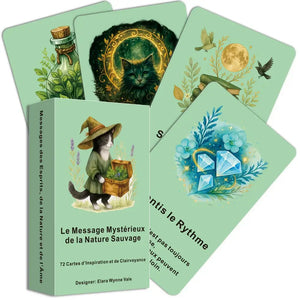
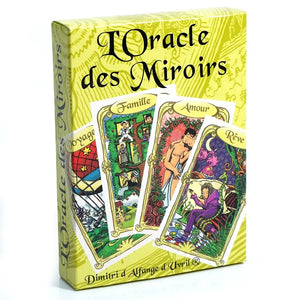
This evolution also explains the proliferation of modern oracle decks, with a wide variety of themes (crystals, nature, introspection), which capture the spirit of card readings without always following the strict structure of the 78 cards in a traditional tarot deck.
🔮
Want to start your own practice?
Discover our selection of tarot decks and oracle cards
View the collection🔮 🌙 ✨
📌 Pin this article so you can easily find it again! | 💬 Share your first reading in the comments!
© 2026 Enjouet — Article written with 🔮 and passion. All rights reserved.